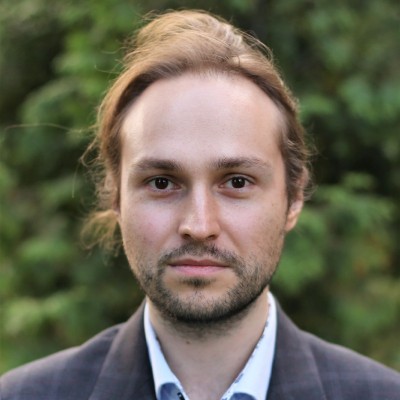
Adam Ścięgaj
Data Scientist
Gdańsk, Pomeranian Voivodeship, Poland



Summary
👤
Senior🎓
Top SchoolAdam Ścięgaj is a Data Scientist with nine years of experience bridging solid and structural mechanics research and practical software development, now applying his skills at Allegro. He holds a PhD in Solid and Structural Mechanics and has led finite element modeling, non-destructive testing, and machine learning work as an assistant professor and PhD researcher. Adam has hands-on expertise porting numerical algorithms to production-grade code—contributing core finite-element functionality to the well-regarded CALFEM Python toolkit—and is comfortable translating MATLAB-era methods into Pythonic implementations. He teaches and mentors in topics from structural dynamics to introductory Python, combining deep theory with practical coding and visualization. Based in Gdańsk, he brings a multidisciplinary perspective that pairs multiscale modelling knowledge with data-driven approaches to structural problems. Notably, his background spans both academia and industry, enabling rapid prototyping of numerical solutions that scale into real-world applications.
 9 years of coding experience
 3 years of employment as a software developer
 Bachelor of Science - BS, Civil Engineering with major in Structural Engineering, Bachelor of Science - BS, Civil Engineering with major in Structural Engineering at Poznan University of TechnologyExchange student, Civil Engineering, Exchange student, Civil Engineering at Luleå University of TechnologyDoctor of Philosophy - PhD, Solid and Structural Mechanics, Doctor of Philosophy - PhD, Solid and Structural Mechanics at Chalmers University of Technology
 Polish, English, Swedish, Russian
Github Skills (8)
finite-element-analysis10
scipy10
python10
numpy10
matlab9
visualization8
visualizations8
ed255197
Programming languages (3)
Github contributions (5)
CALFEM/calfem-python
Aug 2022 - Dec 2022
CALFEM for Python is the Python port of the CALFEM finite element toolkit. It also implements meshing function based on GMSH and triangle. Visualisation routines are implemented using visvis and matplotlib.
Role in this project: Back-end Developer
Back-end DeveloperContributions:10 commits, 2 PRs in 4 months
Contributions summary:Adam primarily contributed to porting functionality from the MATLAB version of the CALFEM finite element toolkit to Python. Their work included implementing core finite element functions, such as those for eigenvalue analysis and beam element calculations. The commits demonstrate expertise in numerical methods and involve modifying existing code to translate algorithms and functionalities from a different programming environment. These contributions directly enhanced the Python port of the CALFEM toolkit, making it more feature-rich.
gmshmatplotlibpythonvisualizationfinite-elements
adsci/speedEST
Apr 2022 - Mar 2023
Vehicle impact speed estimation using machine learning
Contributions:5 releases, 39 commits, 8 PRs in 11 months
machine-learning
Find and Hire Top DevelopersWe’ve analyzed the programming source code of over 60 million software developers on GitHub and scored them by 50,000 skills. Sign-up on Prog,AI to search for software developers.