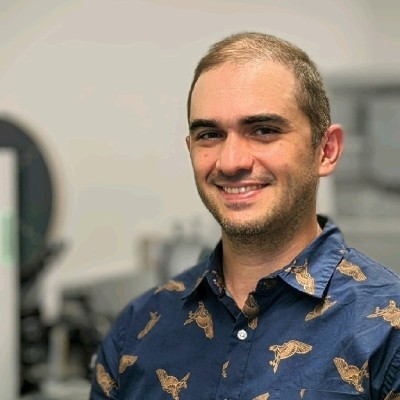
Alejandro Escobar
Research Scientist at Duke University
Raleigh-Durham-Chapel Hill Area United States



Summary
👤
Senior🎓
Top SchoolAlejandro Escobar is a research scientist at Duke University with a decade of experience applying bioinformatics and computational molecular evolution to uncover positive selection in regulatory genomes. He has led methodological improvements that detect selection in open chromatin across humans and chimpanzees and packaged reproducible analyses in a Docker container for testing human accelerated elements. His work spans transcriptome, RNA-seq and single-cell analyses across tissues and species, and he brings hands-on wet-lab expertise from ChIP libraries, cryosectioning, and PCR in non-model organisms. Previously he mapped ancient and recent selection signals in neuroendocrine loci and built genomic resources for prairie voles and singing mice. He mentors students, managed lab biosafety to achieve Green Lab Certification, and holds certifications in geospatial R and NGS bioinformatics. Based in the Raleigh–Durham area, he combines rigorous evolutionary theory with practical, reproducible pipelines that bridge computational and experimental genomics.
 10 years of coding experience
 8 years of employment as a software developer
 PhD, Ecology, Evolution and Behavior, PhD, Ecology, Evolution and Behavior at The University of Texas at AustinBiologist, Cytogenetics, cell biology, meiosis, Biologist, Cytogenetics, cell biology, meiosis at Universidad de AntioquíaPhD student, Biology, PhD student, Biology at University of Florida
 English, Spanish
Github Skills (31)
rna-seq9
genome8
cran8
single-cell-genomics7
bioinformatics7
snapshots7
bcftools7
genomics7
comparative-genomics5
time-series5
evolution4
phylogenetics4
science4
sequence3
scoring3
Programming languages (7)
Github contributions (5)
wodanaz/adaptiPhy
Feb 2018 - Dec 2021
Contributions:1 release, 192 commits, 1 PR in 3 years 9 months
wodanaz/RNA-seq
Jan 2016 - Jun 2024
Contributions:41 pushes, 1 branch in 8 years 5 months
Find and Hire Top DevelopersWe’ve analyzed the programming source code of over 60 million software developers on GitHub and scored them by 50,000 skills. Sign-up on Prog,AI to search for software developers.