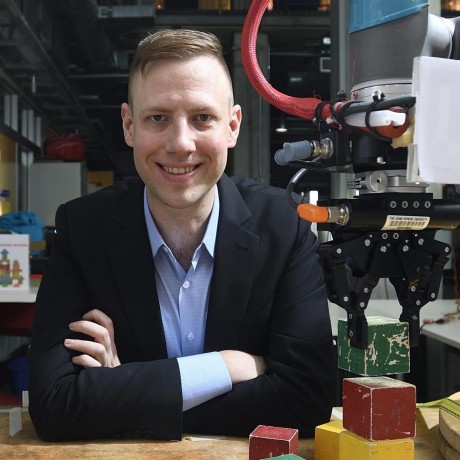
Andrew Hundt
Computing Innovation Postdoctoral Fellow
Pittsburgh, Pennsylvania, United States



Summary
🤩
Rockstar🎓
Top SchoolAndrew Hundt is a Computing Innovation Postdoctoral Fellow and robotics-focused software engineer with 13 years of hands-on experience building integrated learning and traditional algorithms for real-world agents. He combines deep-learning expertise (PyTorch, TensorFlow, Keras) and robotics/vision systems with low-level engineering in C/C++, CAD and build systems to enable smoother robot calibration, perception, and control. His work spans academia and industry—from a PhD at Johns Hopkins and postdocs at CMU and Georgia Tech to a confidential robotics “moonshot” at X—and includes sustained open-source contributions to widely used projects like Keras, Bullet Physics, and hand-eye calibration tools. Known for improving runtime and robustness (e.g., TensorFlow grasping pipelines and reliable hand-eye calibration for UR5/Kuka systems), he also brings strong DevOps, documentation, and mentoring skills that bridge research prototypes to production-grade systems.
 13 years of coding experience
 5 years of employment as a software developer
 Johns Hopkins UniversityBS, BS at Carnegie Mellon University
Stackoverflow
2,601reputation
225kreached
20answers
41questions

Github Skills (48)
debug10
c-language10
robotics10
multiplatform10
python10
data-science10
sphinx10
data-set10
semantic-segmentation10
machine-learning10
build-system10
cmake10
cross-platform10
datasets10
keras10
Programming languages (20)
Github contributions (5)
hengli/camodocal
Apr 2015 - Nov 2017
CamOdoCal: Automatic Intrinsic and Extrinsic Calibration of a Rig with Multiple Generic Cameras and Odometry
Role in this project: Back-end Developer & DevOps Engineer
Back-end Developer & DevOps EngineerContributions:5 releases, 69 commits, 33 PRs in 2 years 7 months
Contributions summary:Andrew primarily focused on improving the codebase's compliance with C++ standards, including replacing deprecated extensions with standard library elements, and making CUDA support optional. They refactored build configurations and library dependencies using CMake, enhancing cross-platform compatibility. The contributions also involved fixing compiler issues related to C++11 support, demonstrating a focus on code maintainability and build system management.
extrinsicvisual-odometryrigodometryintrinsics
aurora95/Keras-FCN
Mar 2017 - Jan 2018
Keras-tensorflow implementation of Fully Convolutional Networks for Semantic Segmentation(Unfinished)
Role in this project:Back-end Developer & DevOps Engineer
Back-end Developer & DevOps EngineerContributions:134 commits, 12 PRs, 6 pushes in 10 months
Contributions summary:Andrew made several changes related to the project's infrastructure and data handling, including modifying file paths and creating a `slurm.sh` script for job management, indicating DevOps involvement. They refactored code within the `train.py`, `evaluate.py`, `inference.py`, and `utils/` modules, suggesting a focus on core functionality. The user also introduced and modified model definitions, particularly for Atrous_DenseNet, indicating backend and potential ML engineering work, possibly for performance optimization.
semantic-segmentationdeep-learningunfinishedconvolutionalconvolutional-networks
Find and Hire Top DevelopersWe’ve analyzed the programming source code of over 60 million software developers on GitHub and scored them by 50,000 skills. Sign-up on Prog,AI to search for software developers.