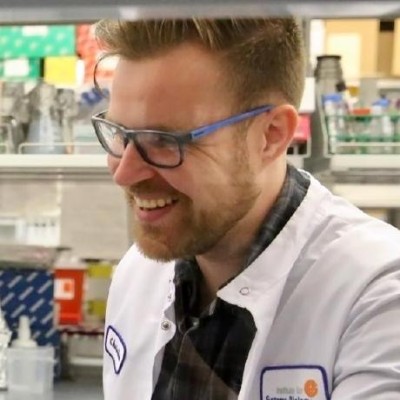
Christian Diener
Assistant Professor at Medizinische Universität Graz
Graz, Styria, Austria



Summary
🤩
Rockstar🎓
Top SchoolChristian Diener is an Assistant Professor and computational microbiome researcher with 12 years’ experience bridging ecology, systems biology, and metabolism to study the human gut. He leads a lab at the Medical University of Graz that combines constraint-based modeling, wet-lab experiments, and an emphasis on equitable, open science to design and interpret complex microbial communities. A summa cum laude PhD in Systems Biology and postdoctoral work on large-scale personalized microbiome projects inform his translational approach to host–microbe metabolic interactions. He is an active open-source contributor to metabolic modeling tooling—improving performance and adding features like flux sampling to the widely used COBRApy package—reflecting a focus on computational efficiency and solver robustness. Colleagues know him for pairing deep technical rigor with accessible teaching and shared software, and for treating microbes as social organisms whose behavior emerges from context. Based in Graz, Austria, he blends hands-on coding, lab experiments, and community-minded science to turn complex data into actionable insights.
 12 years of coding experience
 4 years of employment as a software developer
 Bachelor of Science (B.Sc.), Bioinformatics, Bachelor of Science (B.Sc.), Bioinformatics at Freie Universität BerlinDoctor of Philosophy (Ph.D.), Systems Biology, summa cum laude, Doctor of Philosophy (Ph.D.), Systems Biology, summa cum laude at Max Planck Institute for Molecular Genetics
 English, German, Spanish
Stackoverflow
11reputation
390reached
1answer
0questions

Github Skills (13)
bioinformatics10
constraint-layout10
gurobi10
constraint10
constraint-satisfaction10
python10
modeling10
cplex10
metabolic-models10
numpy9
pandas9
computational-biology9
scipy8
Programming languages (15)
Github contributions (5)
opencobra/cobrapy
Dec 2015 - Jan 2023
COBRApy is a package for constraint-based modeling of metabolic networks.
Role in this project: Back-end Developer / Data Scientist
Back-end Developer / Data ScientistContributions:174 reviews, 145 commits, 149 PRs in 7 years 2 months
Contributions summary:Christian primarily contributed to the codebase by fixing bugs, improving performance, and adding new functionalities to the `cobrapy` package. The contributions include fixing phenotype phase plane issues and issues with specific solvers like CPLEX and Gurobi, which improved model solving capabilities. Other contributions involved fixing memory leaks and improving flux variability analysis, suggesting a focus on computational efficiency and optimization within the constraint-based modeling context of the project. The user also introduced new features, such as flux sampling, which expands the capabilities of the package.
pythonsystems-biologysimulationsbml-simulationbioinformatics
Gibbons-Lab/weight_loss_2019
Oct 2020 - Oct 2021
Contributions:1 release, 45 commits, 24 pushes in 11 months
Find and Hire Top DevelopersWe’ve analyzed the programming source code of over 60 million software developers on GitHub and scored them by 50,000 skills. Sign-up on Prog,AI to search for software developers.