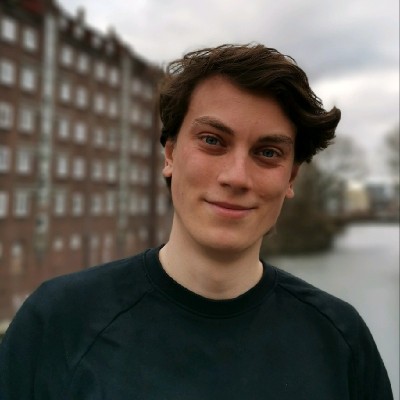
Felix Koehler
PHD Student at Pasteur Labs & ISI
Munich, Bavaria, Germany



Summary
🤩
Rockstar🎓
Top SchoolFelix Koehler is a PhD student at TU Munich specializing in machine learning for physical simulation, with nine years of experience bridging deep learning, adjoint methods, inverse problems, and optimization for fluids and solids. He produces widely accessible educational resources on simulation and ML as a Simulation Intelligence Advocate supported by Pasteur Labs & ISI and runs a technical YouTube channel with accompanying open-source notes and code. His work blends rigorous research (PhD with Nils Thuerey) and industry-facing projects—from Siemens master’s work accelerating CFD with learnt local correction models to an internship at Meta Reality Labs—demonstrating an ability to translate theory into practical simulation tools. A hands-on engineer, he implements low-level sparse matrix representations in C, probabilistic models and EM algorithms in Python/TensorFlow Probability, and creates interactive visualizations to demystify complex math. Based in Munich, he combines academic teaching experience and HPC expertise with a genuine commitment to open science and education.
 9 years of coding experience
 4 years of employment as a software developer
 Exchange Machine Learning, Exchange Machine Learning at KTH Royal Institute of TechnologyMaster of Science - MS Computational Science and Engineering, Master of Science - MS Computational Science and Engineering at Technical University of MunichAbitur, Abitur at Henfling-Gymnasium MeiningenBachelor of Science General Mechanical Engineering, Bachelor of Science General Mechanical Engineering at Technische Universität Braunschweig
 German, English, French, Swedish
Github Skills (15)
simulations10
simulation10
machine-learning10
tensorflow-probability10
python10
c119
c179
algorithms8
mathematics8
data-structures8
algorithm8
data-analysis8
data-structure8
math8
jax6
Programming languages (6)
Github contributions (5)
Ceyron/machine-learning-and-simulation
Feb 2021 - Jan 2023
All the handwritten notes 📝 and source code files 🖥️ used in my YouTube Videos on Machine Learning & Simulation (https://www.youtube.com/channel/UCh0P7KwJhuQ4vrzc3IRuw4Q)
Role in this project: Data Scientist & ML Engineer
Data Scientist & ML EngineerContributions:1 release, 205 commits, 10 PRs in 1 year 11 months
Contributions summary:Felix contributed code related to machine learning and simulation. Specifically, they developed and implemented code for various sparse matrix representations, including coordinate and compressed sparse row formats, using the C programming language. They also implemented the Expectation-Maximization algorithm for a univariate Gaussian Mixture Model using Python and TensorFlow Probability. Additionally, the user created interactive visualizations and plots for several probabilistic models, including the multivariate normal, Gamma, and Normal-Gamma distributions, as well as for the ELBO (Evidence Lower Bound).
notespythondata-sciencehandwritten-notesvideos
Ceyron/4k-turbulence-wallpapers
Mar 2022 - Mar 2022
Contributions:8 commits in 17 days
Find and Hire Top DevelopersWe’ve analyzed the programming source code of over 60 million software developers on GitHub and scored them by 50,000 skills. Sign-up on Prog,AI to search for software developers.