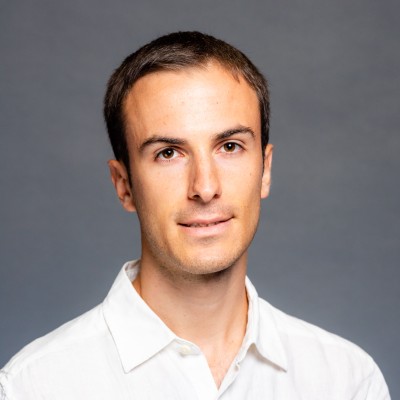
Gabriele Corso
Co-Founder at Boltz
Cambridge, Massachusetts, United States



Summary
🤩
Rockstar🎓
Top SchoolGabriele Corso is a machine learning researcher and entrepreneur with nine years of experience building geometric deep learning and generative models for biochemistry and physics. As Co-Founder of Boltz and a recent PhD student at MIT in Tommi Jaakkola and Regina Barzilay’s labs, he focuses on applying advanced ML to reshape how scientists design and understand biological systems. He has industrial research experience from Twitter Research, D. E. Shaw, and IBM, and production ML deployments from work at Alchera and other engineering roles. Notable open-source contributions include improving DiffDock’s stability and confidence modeling—practical work that bridges ML research and molecular docking applications. Based in Cambridge, MA, he combines rigorous academic training with hands-on engineering across research prototypes and production systems. Colleagues describe him as someone who translates complex geometric ideas into robust tools that accelerate scientific discovery.
 9 years of coding experience
 1 year of employment as a software developer
 Doctor of Philosophy - PhD Artificial Intelligence, Doctor of Philosophy - PhD Artificial Intelligence at Massachusetts Institute of TechnologyBachelor of Arts - BA Computer Science, Bachelor of Arts - BA Computer Science at University of Cambridge
 Italian, English
Stackoverflow
154reputation
3kreached
5answers
6questions

Github Skills (15)
diffusion-models10
pytorch10
machine-learning10
python10
computational-biology9
binding8
tensorflow7
android-permissions6
android-array-adapter6
android6
backend6
androidmanifest6
adapter6
backendless6
android-activity6
Programming languages (5)
Github contributions (5)
gcorso/DiffDock
Oct 2022 - Nov 2022
Implementation of DiffDock: Diffusion Steps, Twists, and Turns for Molecular Docking
Role in this project: ML Engineer
ML EngineerContributions:1 review, 14 commits, 4 PRs in 1 month
Contributions summary:Gabriele made several commits focused on improving the functionality and stability of the DiffDock implementation. They addressed issues related to molecule processing and handling errors, modifying the `read_molecule` function to prevent failures with unreadable molecules. Further, they worked on enhancing the confidence model by fixing checkpoint loading and improving memory usage, including modifications to the dataset and training scripts. They also corrected an indexing issue in the score model, ensuring the correct center convolution calculations.
dockingnon-euclidean-geometryscore-based-modelsmolecular-dockingmachine-learning
gcorso/android_academy
Aug 2018 - Jan 2019
Android educational app template, use it and you will only need to focus on the contents of your courses in order to quickly launch your app idea. The repository is a boilerplate of an Android Studio project and includes by layout files, activities control and database integration, everything already set up for you so that you can get a headstart to bring your project to life.
Contributions:40 commits, 2 PRs, 36 pushes in 4 months
everythingmvvmcomposeapp-templatebuildsrc
Find and Hire Top DevelopersWe’ve analyzed the programming source code of over 60 million software developers on GitHub and scored them by 50,000 skills. Sign-up on Prog,AI to search for software developers.