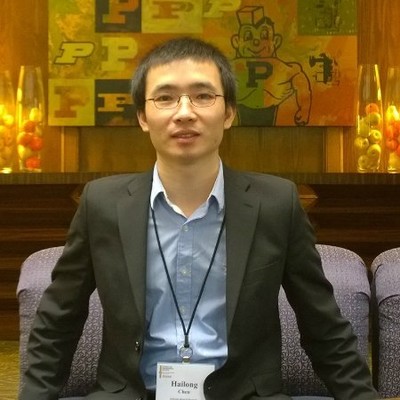
Hailong Chen
Associate Professor
Lexington, Kentucky, United States



Summary
👤
Senior🎓
Top SchoolHailong Chen is an Associate Professor of Mechanical & Aerospace Engineering at the University of Kentucky with a decade of experience bridging computational mechanics research and software development. His work spans nonlocal and peridynamics modeling, fracture and fatigue analysis, and uncertainty quantification, informed by postdoctoral roles at Idaho National Laboratory and Arizona State University. He contributes to major open-source simulation infrastructure such as the MOOSE framework, improving tensor mechanics, boundary condition implementations, and peridynamics mesh integration. With a Ph.D. from Arizona State University and a track record of translating advanced theory into tested, production-grade code and models, he blends rigorous academic research with practical engineering solutions. An often-overlooked strength is his hands-on experience across the full modeling pipeline—from voxel-based materials design to finite element implementations—enabling multiscale, multidisciplinary approaches to materials failure.
 10 years of coding experience
 14 years of employment as a software developer
 Doctor of Philosophy (Ph.D.), Mechanical Engineering, 3.81/4.00, Doctor of Philosophy (Ph.D.), Mechanical Engineering, 3.81/4.00 at Arizona State UniversityBachelor of Science in Engineering, Mechanical Engineering, 3.63/4.00, Bachelor of Science in Engineering, Mechanical Engineering, 3.63/4.00 at Shanghai Normal UniversityMaster’s Degree, Mechanical Engineering, 3.79/4.00, Master’s Degree, Mechanical Engineering, 3.79/4.00 at University of Florida
 English, Chinese
Github Skills (10)
c-language10
tensor10
tensorflow10
f10
cprogramming-language10
el10
object-oriented-programming9
numerical-methods9
simulations8
simulation8
Programming languages (2)
Github contributions (5)
idaholab/moose
Apr 2019 - Dec 2020
Multiphysics Object Oriented Simulation Environment
Role in this project: Back-end Developer
Back-end DeveloperContributions:6 reviews, 30 commits, 51 PRs in 1 year 7 months
Contributions summary:Hailong implemented and modified code related to tensor mechanics within the MOOSE framework, specifically addressing issues related to coupling between scalar out-of-plane strain and displacements. They also contributed to the implementation of penalty Dirichlet boundary conditions for nodesets, enhancing the framework's capabilities. Further work involved refactoring and updating the peridynamics mesh implementation, integrating existing mesh generators and selectively converting FE blocks. Additionally, they added various tests and improved existing ones, showing focus on quality and functionality.
pythonfinite-element-analysisfemparallelmultiphysics
hchen139/moose
Jan 2016 - Dec 2024
Multiphysics Object Oriented Simulation Environment
Contributions:4 PRs, 312 pushes, 114 branches in 9 years
pythonmultiphysicssimulationsimulation-environmentobject-oriented
Find and Hire Top DevelopersWe’ve analyzed the programming source code of over 60 million software developers on GitHub and scored them by 50,000 skills. Sign-up on Prog,AI to search for software developers.