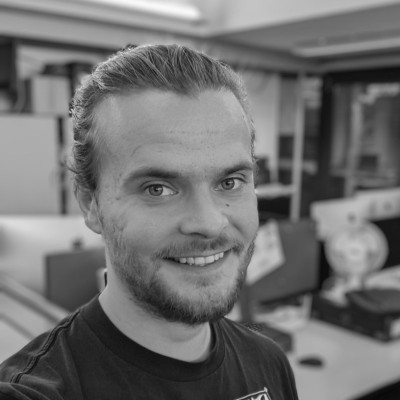
Leevi Kerkelä
Research Engineer at algo1
United Kingdom



Summary
👤
Senior🎓
Top SchoolLeevi Kerkelä is a research engineer and machine learning researcher with a decade of experience applying physics-trained quantitative thinking to neuroimaging, graph deep learning, and blockchain-enabled platforms. He holds a PhD in Neuroimaging from UCL and has built CUDA-accelerated simulators and clinical neuroimaging tools while contributing substantial features to the widely used medical imaging library DIPY (including Q-space trajectory imaging support). Leevi has moved between academia and industry—translating advanced imaging methods to clinical use, researching DeFi and blockchain integrations, and now building hyper-personalisation ML systems—demonstrating a rare blend of low-level scientific computing and production ML engineering. Comfortable across back-end systems, data pipelines and GPU code, he brings multidisciplinary fluency spanning theoretical physics, biophysics and economics that helps bridge domain research and product delivery.
 10 years of coding experience
 7 years of employment as a software developer
 Master of Science Biophysics, Master of Science Biophysics at University of Copenhagen (Københavns Universitet)Erasmus exchange Physics Economics, Erasmus exchange Physics Economics at Universidad Complutense de MadridBachelor of Science Theoretical Physics, Bachelor of Science Theoretical Physics at University of HelsinkiUniversity College London
 Spanish, English, Finnish
Stackoverflow
1reputation
0reached
0answers
0questions

Github Skills (9)
data-analysis10
medical-imaging10
diffusion-mri10
python10
numpy10
data-structure9
algorithm9
data-structures9
algorithms9
Programming languages (5)
Github contributions (5)
dipy/dipy
Feb 2020 - Feb 2022
DIPY is the paragon 3D/4D+ medical imaging library in Python. Contains generic methods for spatial normalization, signal processing, machine learning, statistical analysis and visualization of medical images. Additionally, it contains specialized methods for computational anatomy including diffusion, perfusion and structural imaging.
Role in this project: Back-end Developer & Data Scientist
Back-end Developer & Data ScientistContributions:48 commits, 2 PRs, 20 comments in 2 years
Contributions summary:Leevi significantly contributed to the development of the `GradientTable` class, adding functionality for handling various b-tensor shapes (linear, planar, spherical, and cigar-shaped) and volume-specific tensor definitions. They also implemented functions for calculating the DTD covariance and generating diffusion-weighted signals. Furthermore, they introduced the `QtiModel` and `QtiFit` classes for performing Q-space trajectory imaging, incorporating OLS and WLS fitting methods, and calculating essential parameter maps.
signalpythonmicrostructurespatialtractography
kerkelae/dkmri
Jan 2022 - Apr 2022
Contributions:84 commits, 50 pushes, 4 branches in 2 months
Find and Hire Top DevelopersWe’ve analyzed the programming source code of over 60 million software developers on GitHub and scored them by 50,000 skills. Sign-up on Prog,AI to search for software developers.