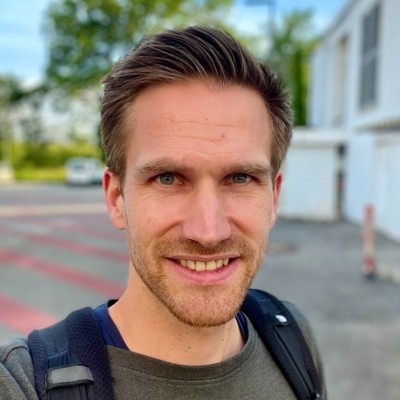
Michael Schenk
Applied Physicist at CERN
Meyrin, Geneva, Switzerland



Summary
👤
Senior🎓
Top SchoolMichael Schenk is an applied physicist and machine learning engineer with 12 years of experience designing and deploying AI-driven control and optimization systems for particle accelerators at CERN and EPFL. He combines deep expertise in numerical modeling, scientific computing, and reinforcement learning with hands-on Python software development to turn experimental accelerator data into production-ready ML solutions. His work spans from proposing and running accelerator experiments to building conditional generative models and RL agents for multi-parameter optimization, and he has authored peer-reviewed research while supervising students. Fluent in multinational, multidisciplinary teams, he excels at bridging theoretical modeling and practical implementation—an asset demonstrated by experiments and ML models that directly improve beam stability and operational performance.
 12 years of coding experience
 2 years of employment as a software developer
 Master's degree, Engineering Physics/Applied Physics, Summa cum laude, Master's degree, Engineering Physics/Applied Physics, Summa cum laude at University of BernDoctor of Philosophy - PhD, Accelerator Physics, EPFL Physics Thesis Distinction, Doctor of Philosophy - PhD, Accelerator Physics, EPFL Physics Thesis Distinction at EPFL (École polytechnique fédérale de Lausanne)
 German, English, French, Greek
Github Skills (7)
particle10
dynamics10
simulation9
beam8
building-blocks3
jupyter-notebook1
accelerator1
Programming languages (2)
Github contributions (5)
michuschenk/sps-zs-modelling
Jun 2019 - Jun 2020
Contributions:10 pushes, 2 branches in 1 year
michuschenk/qbm-rl-steering
May 2022 - May 2023
Contributions:9 pushes, 3 branches in 1 year
Find and Hire Top DevelopersWe’ve analyzed the programming source code of over 60 million software developers on GitHub and scored them by 50,000 skills. Sign-up on Prog,AI to search for software developers.