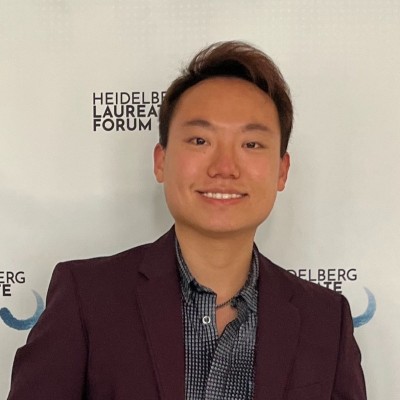
Paul Liang
Assistant Professor at Massachusetts Institute of Technology
Cambridge, Massachusetts, United States



Summary
🤩
Rockstar🎓
Top SchoolPaul Liang is an Assistant Professor at the MIT Media Lab and MIT EECS who directs the Multisensory Intelligence group, developing foundational AI that fuses signals across sensory modalities to enable human-AI symbiosis for productivity, creativity, and wellbeing. With 11 years of experience spanning a PhD in Machine Learning from Carnegie Mellon and research internships at DeepMind, Google, NVIDIA, and Meta, he blends cutting-edge theory with real-world system building. His work bridges ML, neural computation, and multisensory perception, and he has contributed to prominent open collaborative efforts such as BIG-bench by implementing fairness evaluations that probe gender and religion biases in language models. Paul’s background as both an educator and researcher gives him a knack for translating complex models into usable tools and experiments, and he often explores cross-scale interactions between perception and cognition that aren’t obvious from typical ML labs. Based in Cambridge, MA, he focuses on research with clear societal impact while maintaining strong ties to industry and open science.
 11 years of coding experience
 6 years of employment as a software developer
 High School Diploma, High School Diploma at Raffles InstitutionPhD Machine Learning, PhD Machine Learning at Carnegie Mellon University
 Chinese, English
Github Skills (8)
workbench10
machine-learning10
nlp10
testbench10
python10
natural-language-processing10
data-analysis10
numpy9
Programming languages (5)
Github contributions (5)
google/BIG-bench
Mar 2021 - Jul 2021
Beyond the Imitation Game collaborative benchmark for measuring and extrapolating the capabilities of language models
Role in this project: Data Scientist
Data ScientistContributions:46 commits, 4 PRs, 13 comments in 4 months
Contributions summary:Paul primarily contributed to the development of a fairness task within the repository. Their work involved defining and implementing methods to evaluate bias in language models, specifically focusing on gender and religion. They created and modified code to calculate Hellinger distances between probability distributions of gender/religion swapped contexts. This included the creation of helper functions, and dataset integration to test models.
bertmachine-learningbenchmarkmeasuringbenchmarks
pliang279/MFN
Dec 2018 - Aug 2020
Code for Memory Fusion Network, AAAI 2018
Contributions:24 commits, 2 PRs, 19 pushes in 1 year 7 months
pytorchmemorynetwork-fusiondeep-learningmachine-learning
Find and Hire Top DevelopersWe’ve analyzed the programming source code of over 60 million software developers on GitHub and scored them by 50,000 skills. Sign-up on Prog,AI to search for software developers.