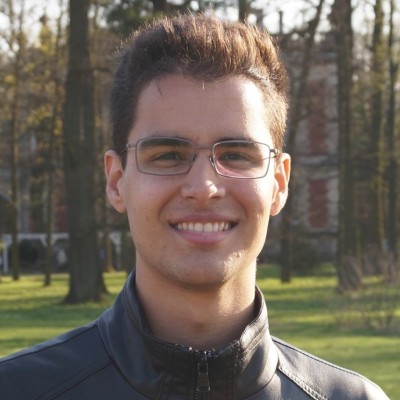
Pedro Figueirêdo
Graduate Research Assistant
College Station, Texas, United States



Summary
👤
Senior🎓
Top SchoolPedro Figueirêdo is a final-year Ph.D. candidate and research engineer blending physically based rendering with generative AI to build fast, hardware‑efficient neural light transport systems. Over nine years he’s prototyped large diffusion models in PyTorch and hand‑optimized C++/CUDA neural modules, shipping work published at SIGGRAPH, EGSR, and WACV and validated through internships at Intel and NVIDIA. His research tackles practical scalability—managing scenes with hundreds of thousands of lights via residual hierarchies and tiny MLP CUDA extensions—and bridges synthetic-to-real gaps with reinforcement-learned realism rewards for SVBRDF generation. He pairs deep systems-level performance work with creative algorithm design, like decomposing directional distributions into paired 1D PDFs and hypernetwork-guided interpolation without ground-truth intermediates. Based in College Station, Texas, he’s seeking Research Scientist/Engineer roles to continue fusing graphics and AI to raise virtual-fidelity while keeping an eye on production constraints. An uncommon strength is his ability to move seamlessly between rapid diffusion-model fine‑tuning and low‑level GPU coding to deliver research that’s both novel and deployable.
 9 years of coding experience
 4 years of employment as a software developer
 Doctor of Philosophy - PhD, Computer Science, Doctor of Philosophy - PhD, Computer Science at Texas A&M UniversityBachelor's degree, Computer Science, Bachelor's degree, Computer Science at Eötvös Loránd UniversityBachelor's degree, Computer Engineering, Bachelor's degree, Computer Engineering at Universidade Federal da Paraíba
 English, Portuguese, Spanish, Hungarian
Github Skills (22)
python8
tracer8
deep-learning8
gpu8
machine-learning8
rendering7
wsl27
theory7
ray6
neural-network6
pbrt6
tensorflow6
raytracing6
numpy5
windows5
Programming languages (4)
Github contributions (5)
pedrovfigueiredo/frameintIFE
Sep 2022 - Jan 2023
Contributions:9 commits, 4 pushes, 1 branch in 3 months
pedrovfigueiredo/LogonRenderer
Apr 2017 - Apr 2019
Contributions:33 pushes, 5 branches in 2 years
Find and Hire Top DevelopersWe’ve analyzed the programming source code of over 60 million software developers on GitHub and scored them by 50,000 skills. Sign-up on Prog,AI to search for software developers.