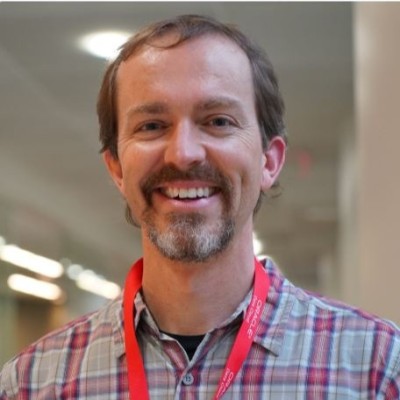
Philip Ogren
Consulting Research Scientist at Oracle
Boulder, Colorado, United States



Summary
🤩
Rockstar🎓
Top SchoolPhilip Ogren is a Consulting Research Scientist based in Boulder with 11 years of experience applying machine learning, NLP, and information retrieval to production systems. At Oracle he builds LLM-driven developer agents and has deep hands-on expertise in Java and Scala toolchains, contributing performance and tokenizer improvements to notable open-source projects like Tribuo and FACTORIE. He holds a Ph.D. in Computer Science from the University of Colorado Boulder and has taught graduate NLP, bridging research and applied engineering. Pragmatic and detail-oriented, he has a track record of refactoring core data structures and inference components to make probabilistic models and sequence datasets more efficient and maintainable.
 11 years of coding experience
 1 year of employment as a software developer
 Ph.D., Computer Science, Ph.D., Computer Science at University of Colorado at BoulderM.S., Computer Science, M.S., Computer Science at University of Colorado BoulderB.S., Mathematics, B.S., Mathematics at Harding University
Github Skills (18)
algorithms10
machine-learning10
data-structure10
java10
scala10
javas10
computer-engineering10
data-structures10
nlp10
algorithm9
classification9
datastructures-algorithms9
factors8
graph8
regression7
Programming languages (3)
Github contributions (5)
oracle/tribuo
Jul 2020 - Sep 2022
Tribuo - A Java machine learning library
Role in this project: Back-end Developer
Back-end DeveloperContributions:112 reviews, 6 commits, 7 PRs in 2 years 1 month
Contributions summary:Philip primarily contributed to the core Java machine learning library, Tribuo. They focused on refactoring and optimizing existing code related to datasets, specifically `MinimumCardinalitySequenceDataset`, and introduced new functionalities like `MinimumCardinalitySequenceDataset` and `BinaryFeaturesExample` for efficient feature handling. Additionally, the user addressed bugs in the `LabelConfusionMatrix` and implemented the `Wordpiece` tokenizer, demonstrating expertise in improving data processing and model building components of the library. Furthermore, they refactored and enhanced the `SequenceExample` class.
nlpregressiondata-preprocessingdeep-learningmachine-learning
factorie/factorie
Apr 2015 - Sep 2016
FACTORIE is a toolkit for deployable probabilistic modeling, implemented as a software library in Scala. It provides its users with a succinct language for creating relational factor graphs, estimating parameters and performing inference.
Role in this project:Back-end Developer
Back-end DeveloperContributions:12 commits in 1 year 4 months
Contributions summary:Philip primarily contributed to the Factorie library, focusing on the implementation of NLP-related features and improvements. Their work involved modifying existing code for Aho-Corasick string matching automaton and model components. They also refactored the training processes and made changes to the core components to improve model performance and maintainability, showcasing a strong understanding of the library's internal workings.
library-softwareparametersrelationaldeployableprobabilistic-modeling
Find and Hire Top DevelopersWe’ve analyzed the programming source code of over 60 million software developers on GitHub and scored them by 50,000 skills. Sign-up on Prog,AI to search for software developers.