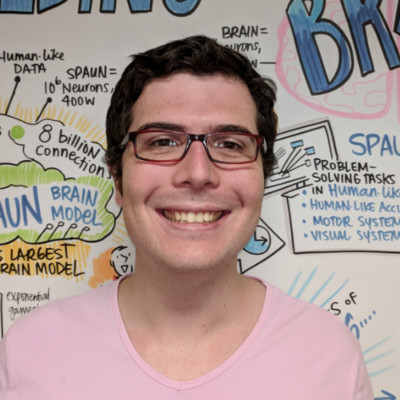
Sean Aubin
Senior Research Engineer at Thomson Reuters
Old Toronto, Ontario, Canada



Summary
🤩
Rockstar🎓
Top SchoolSean Aubin is a Senior Research Engineer with 13 years of experience turning theoretical ML and neuroscience ideas into production-grade systems across biotech, utilities, and enterprise domains. He has led large-scale peptide optimization and ML deployment efforts—using Ray, Argo/Argo Workflows, Kubernetes and ONNX—to accelerate drug discovery throughput by orders of magnitude. Equally at home prototyping models (PyTorch Lightning, Temporal workflows) and productionizing them, he blends research rigor from a MASc in Systems Design Engineering with practical engineering: CI, data pipelines, and annotation workflows. An active open-source contributor, he’s improved core documentation and functionality in Nengo (a prominent neural simulation library) and enhanced visualization in the protein graph library Graphein. Curious and systems-minded, Sean often bridges gaps between wetlab scientists and engineers, teaching tooling and translating prototypes into scalable workflows.
 12 years of coding experience
 6 years of employment as a software developer
 Master of Applied Science, Systems Design Engineering, 93.00, Master of Applied Science, Systems Design Engineering, 93.00 at University of Waterloo
 French, English
Stackoverflow
9,028reputation
1.7mreached
76answers
119questions
powershell
top-5%
anaconda
top-5%
python
top-5%
pandas
top-5%
conda
top-5%

Github Skills (25)
data-visualizations10
python10
ng10
matplotlib10
data-visualisation10
neuroscience10
neural-network10
data-visualization10
plotly10
documentation10
pandas9
conda9
anaconda9
bioinformatics9
proteins9
Programming languages (20)
Github contributions (5)
nengo/nengo
Jul 2014 - Jun 2018
A Python library for creating and simulating large-scale brain models
Role in this project: Back-end Developer & Technical Writer
Back-end Developer & Technical WriterContributions:42 commits, 39 PRs, 231 pushes in 4 years
Contributions summary:Sean contributed to the documentation and core functionality of the Nengo library. They improved the docstrings and added a probe label attribute in `nengo/probe.py`. Additionally, the user made documentation updates, including significant improvements to the developer guide and converting guide, which indicates an active role in refining the project's documentation for other users and developers. They also added themselves to the contributor's list.
brainpython-libraryneurosciencepythondeep-learning
a-r-j/graphein
Apr 2021 - Apr 2021
Protein Graph Library
Role in this project:Back-end Developer
Back-end DeveloperContributions:5 reviews, 7 commits, 2 PRs in 7 days
Contributions summary:Sean contributed to the protein structure graph library by implementing and refining visualization features using Plotly and Matplotlib. They focused on improving the display of protein structures, including edge rendering and node coloring. Additionally, the user made changes to configuration and data type definitions, suggesting contributions to the library's core functionality and data handling. These commits improve how the graph library visualizes protein structure data.
pythonpdbbioinformaticsprotein-data-bankprotein-design
Find and Hire Top DevelopersWe’ve analyzed the programming source code of over 60 million software developers on GitHub and scored them by 50,000 skills. Sign-up on Prog,AI to search for software developers.