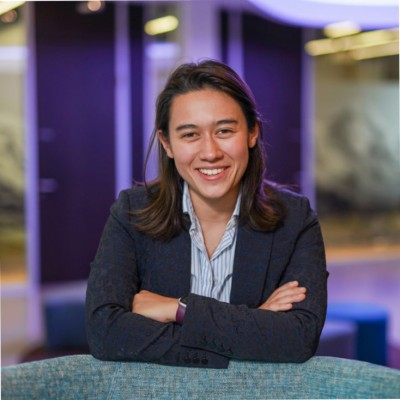
Siméone De Fremond
Associate
Geneva, Geneva, Switzerland



Summary
👤
Senior🎓
Top SchoolSiméone De Fremond is an Associate at McKinsey & Company with nine years of experience at the intersection of life sciences strategy and digital transformation. She combines an MSc in Computer Science (AI) from ETH Zurich and a BSc in AI from the University of Manchester with hands-on machine learning research—her master’s thesis explored structured sparsity in transformers at ETH’s SPCL. Fluent in French, English and Chinese and based in Geneva, she brings a rare blend of consulting rigor and technical depth to client engagements. Her background spans product-focused internships in digital strategy for Air France and entrepreneurial ventures building cross-cultural platforms and a creator network, reflecting strong client empathy and go-to-market instincts. Currently part of McKinsey’s Digital & Analytics community and enrolled at Columbia Business School (MBA), she bridges advanced ML methods and business strategy to drive practical impact. A classically trained pianist with top conservatory honors, she often leverages cultural fluency and creative thinking in analytical problem solving.
 9 years of coding experience
 4 years of employment as a software developer
 Bachelor of Science - BS, Artificial Intelligence, 81.07, Bachelor of Science - BS, Artificial Intelligence, 81.07 at The University of ManchesterBaccalauréat, Général Scientifique Option Internationale Section Américaine, Highest distinction: 18,45/20, Baccalauréat, Général Scientifique Option Internationale Section Américaine, Highest distinction: 18,45/20 at Ecole Jeannine ManuelMBA, MBA at Columbia Business SchoolCertificat d'études musicales, Piano, Highest distinction with unanimous jury congratulations, Certificat d'études musicales, Piano, Highest distinction with unanimous jury congratulations at Conservatoire municipal de Paris 7e arrondissementMaster of Science - MS, Computer Science, Master of Science - MS, Computer Science at ETH Zürich
 French, English, Chinese, German
Stackoverflow
11reputation
193reached
3answers
0questions

Github Skills (34)
music-generation10
pygame10
theano9
lstm9
margin9
time-series-forecasting9
midi9
python8
music8
keras-tensorflow8
keras7
deep-learning7
fpga6
gaussian6
valueerror6
Programming languages (2)
Github contributions (5)
Simeonedef/music_gen_deep_learning
Oct 2018 - May 2020
Music Generation using Deep Learning in Python with Tensorflow & Keras
Contributions:26 commits, 23 pushes, 1 branch in 1 year 7 months
pythonmusic-generationdeep-learninglstmmidi
Simeonedef/Time-Series_Imaging_Forecasting
Mar 2020 - May 2020
In this project we have explored the use of imaging time series to enhance forecasting results with Neural Networks. The approach has revealed itself to be extremely promising as, both in combination with an LSTM architecture and without, it has out-performed the pure LSTM architecture by a solid margin within our test datasets.
Contributions:10 commits, 9 pushes, 1 branch in 2 months
forecastingtest-datasetsimagingseriestime-series
Find and Hire Top DevelopersWe’ve analyzed the programming source code of over 60 million software developers on GitHub and scored them by 50,000 skills. Sign-up on Prog,AI to search for software developers.