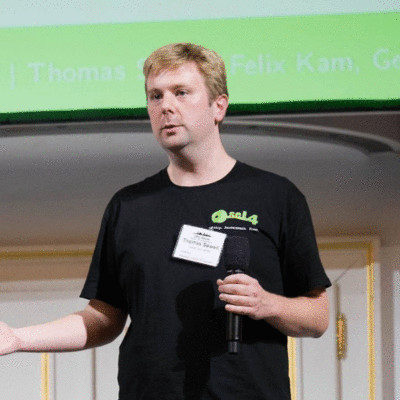
Thomas Sewell
Lecturer at UNSW
Sydney, New South Wales, Australia



Summary
🤩
Rockstar🎓
Top SchoolThomas Sewell is a lecturer and researcher specializing in software verification and formal methods, with a decade of experience building and verifying provably correct systems. He has contributed to high-profile, rigorously verified projects such as seL4 and CakeML and made substantive backend improvements to the HOL4 theorem prover, demonstrating deep expertise in theorem proving, logic solvers and verified compiler infrastructure. His academic path spans postdoctoral research at Cambridge and Chalmers and industry research roles at CSIRO/Data61 and NICTA, giving him a rare blend of theoretical foundations and practical verification engineering. Based in Sydney and currently at UNSW, he combines proof engineering with performance-minded refactors—fixing brittle proofs and adding optimizations that improve real-world usability. Colleagues know him as a “baby academic and itinerant proof engineer” who enjoys plumbing the foundations of mathematics to make formal tools more robust and performant.
 10 years of coding experience
 15 years of employment as a software developer
 UNSW Sydney
Github Skills (9)
data-structures10
compiler10
theorem-proving10
algorithms10
sml10
formal-verification10
data-structure10
hol9
code-optimization8
Programming languages (9)
Github contributions (5)
CakeML/cakeml
Sep 2018 - Jun 2022
CakeML: A Verified Implementation of ML
Role in this project: Back-end Developer
Back-end DeveloperContributions:452 commits, 36 PRs, 251 pushes in 3 years 9 months
Contributions summary:Thomas appears to be involved in modifying and improving the CakeML verified implementation of ML project. They fixed a proof in `word_allocProofScript` broken by a HOL4 change. They also added optional timing in `ml_translatorLib` and implemented changes to improve the functionality and performance of the project. The user further refactored the code for the compiler.
smlverifiedtheorem-provingsatformal-verification
HOL-Theorem-Prover/HOL
Oct 2018 - May 2022
Canonical sources for HOL4 theorem-proving system. Branch develop is where “mainline development” occurs; when develop passes our regression tests, master is merged forward to catch up.
Role in this project:Back-end Developer
Back-end DeveloperContributions:51 commits, 19 PRs, 44 comments in 3 years 8 months
Contributions summary:Thomas made significant contributions to the HOL4 theorem-proving system, primarily focused on optimizing and extending its core functionality. Their work included improving the performance of the `PERM_ELIM_DUPLICATES_CONV` conversion by implementing a more efficient algorithm and adding a new conversion (`ALL_DISTINCT_CONV`). Further, they extended the system's capabilities by introducing a function `toSortedAList` to the sptree library, improving the efficiency of the data structure's operations. These changes demonstrate a strong understanding of the system's internal logic.
pythonsatsat-solversourcesmerged
Find and Hire Top DevelopersWe’ve analyzed the programming source code of over 60 million software developers on GitHub and scored them by 50,000 skills. Sign-up on Prog,AI to search for software developers.