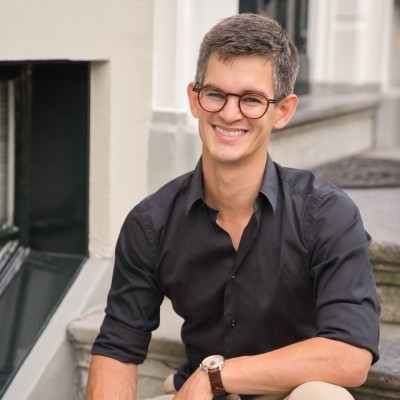
Tim Bakker
Senior Machine Learning Researcher at Qualcomm
Amsterdam, North Holland, Netherlands



Summary
👤
Senior🎓
Top SchoolTim Bakker is a Senior Machine Learning Researcher with eight years of experience bridging academic rigor and industry impact, recently joining Qualcomm to advance reinforcement learning, LLM reasoning, and AI safety. He completed a PhD in machine learning at the University of Amsterdam focused on efficient deep learning, active learning, and active sensing, and contributed to high-profile open-source work such as Facebook Research’s fastMRI by improving VarNet-based MRI reconstruction components. Comfortable moving between theory and applied systems, he has interned at FAIR and Qualcomm and previously built ML solutions for industry at BrainCreators. An aspiring effective altruist, Tim combines technical depth in Bayesian and decision-theoretic thinking with a long-term focus on coordination and existential risk, and — not obvious from his CV — he’s an avid musical theatre singer.
 8 years of coding experience
 7 years of employment as a software developer
 Master’s Degree Theoretical Physics, Master’s Degree Theoretical Physics at University of AmsterdamDiploma vwo (Gymnasium) - Cum Laude natural sciences track, Diploma vwo (Gymnasium) - Cum Laude natural sciences track at Blaise Pascal College
 Dutch, English, German, French
Github Skills (6)
pytorch10
convolutional-neural-networks10
deep-learning10
python10
numpy9
medical-imaging9
Programming languages (6)
Github contributions (5)
facebookresearch/fastMRI
Aug 2021 - Apr 2022
A large-scale dataset of both raw MRI measurements and clinical MRI images.
Role in this project: ML Engineer
ML EngineerContributions:12 reviews, 8 commits, 14 PRs in 8 months
Contributions summary:Tim primarily contributed to the `fastmri` repository by modifying core components related to MRI reconstruction using deep learning. Their work involved enhancements to the `EquispacedMaskFunc`, introducing features like `skip_low_freqs` and `skip_around_low_freqs` for improved mask functionality. They also integrated an option for setting the number of low-frequency lines in the `VarNet` and `VarNetModule`, and updated the `AdaptiveVarNet` model, indicating a focus on model architecture and functionality within the fastMRI reconstruction framework.
clinicalfastmri-datasetfastmrimri-reconstructionneuroimaging
Timsey/pg_mri
Nov 2019 - Mar 2022
Contributions:466 commits, 13 pushes, 1 branch in 2 years 3 months
Find and Hire Top DevelopersWe’ve analyzed the programming source code of over 60 million software developers on GitHub and scored them by 50,000 skills. Sign-up on Prog,AI to search for software developers.